“Accelerated economic growth in Africa, fuelled by significant international investment (particularly in Anglophone Africa), means that businesses and commercial organisations require and demand advice on cross-border commercial litigation and will continue to do so increasingly in the future.
In 1962, President Nkrumah of Ghana emphasised the importance of lawyers from Ghana becoming acquainted with the law of other African countries, so as constantly to ‘increase inter-African economic and cultural relations”. His words are all the more relevant today, given the economic development in Africa in recent decades. With this increased intra and extra-continental trade, the scope for the occurrence of commercial disputes has expanded and will only continue to expand.
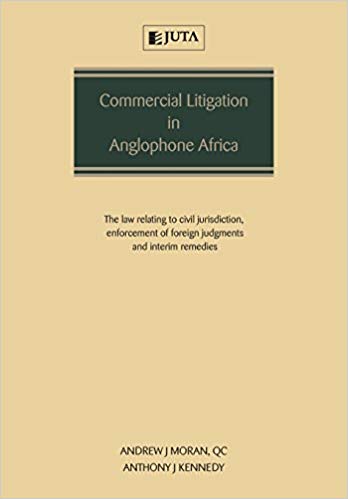
With these developments firmly in mind, in Commercial Litigation in Anglophone Africa, Andrew Moran QC and Anthony Kennedy, for the first time in a work of this nature, set out the broad framework of the private international law rules in operation in each of the sixteen Anglophone jurisdictions considered (Botswana, Gambia, Ghana, Kenya, Lesotho, Liberia, Malawi, Namibia, Nigeria, Sierra Leone, South Africa, Swaziland, Tanzania, Uganda, Zambia and Zimbabwe). Specifically, the authors identify and clarify the law to be applied as it relates to:
- Civil jurisdiction over commercial disputes involving a foreign element ;
- The availability and nature of interim remedies in each of the 16 jurisdictions addressed; and
- The enforcement of foreign judgements in all of the jurisdictions.
As Associate Professor Ada Ordor of the University of Cape Town has recognised, the key benefits of the book include:
- the fact that the authors’ analysis of the procedural law on commercial litigation in Anglophone Africa is underpinned by principles, like the practice of judicial precedent and the application of the rules of statutory interpretation by courts, which unite the common-law world;
- the fact that it brings together in one place the law and practice on commercial litigation in Africa’s Anglophone countries and so holds much value for comparative research; and
- it provides clarity on national laws and the domestic remedies which they provide, which clarity is all the more important given the increasing use of the continent’s regional courts by private citizens and companies in respect of causes of action arising in commerce.”
- And contains a link to the Juta website and/or Amazon (probably need to discuss which/both with you), via which people can then buy a copy of the book.